
The regional trend in one paragraph
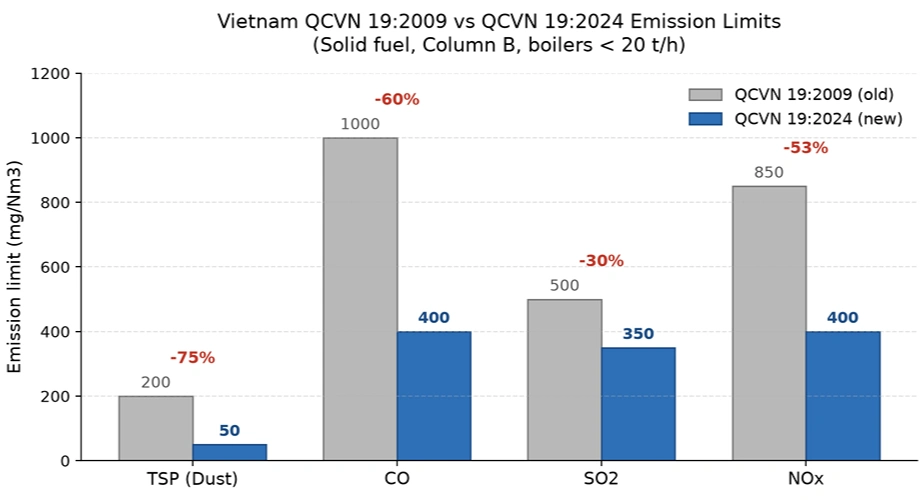
- Tighter numeric limits. Vietnam’s QCVN 19:2024/BTNMT (issued 30 December 2024) cuts column-B CO limits from 1,000 to 400 mg/Nm³, a 60% reduction, and tiers solid-fuel limits by unit capacity. Malaysia replaced its loose 1978 limits with the Environmental Quality (Clean Air) Regulations 2014. Singapore brought existing plants up to revised PM, NOx, CO and SO₂ limits by July 2023.
- Continuous monitoring, not periodic stack testing. Thailand made Continuous Emission Monitoring Systems (CEMS) mandatory for more than 600 large factories on 10 June 2023, and an August 2024 amendment extended the CEMS annexes to 13 industry categories. Malaysia’s 2014 regulations already require continuous monitoring for sources above 10 MW.
- Capacity-tiered and fuel-tiered limits. Small packaged boilers (<10 MW thermal / <50 HP) are still lightly regulated in several countries, but medium and large units face explicit PM, NOx, SO₂, Hg and CO ceilings that differ by gas / liquid / solid fuel.
- Carbon pricing is stacking on top. Singapore’s carbon tax rose to S$25/tCO₂e in 2024 and is scheduled to reach S$50–80 by 2030; Vietnam and Indonesia are operating or expanding their own carbon-pricing schemes. Fuel choice now has a direct cost dimension, not just an emission limit.
Country-by-country snapshot
| Country | Lead authority | Key instrument | What it controls | Notable recent change |
| Indonesia | Ministry of Environment & Forestry (KLHK) | PermenLHK No. 15/2019 (thermal power); regional governor rules | PM, NOx, SO₂, CO, Hg, HCl, HF, NH₃; palm-oil biomass boilers regulated separately | Existing coal units capped at ~550 mg/Nm³ SO₂, ~550 NOx, ~100 PM; regional rules (e.g. East Java) can be stricter |
| Thailand | Ministry of Industry (MIND); MNRE | Factory Air Pollution Notifications; Power Plant Standard B.E. 2566 (2023) | Dust/TSP, SO₂, NOx, CO; opacity | Mandatory CEMS for >600 large factories from Jun 2023; Aug 2024 amendment extends CEMS to 13 industries |
| Vietnam | Ministry of Agriculture & Environment (formerly MONRE) | QCVN 19:2024/BTNMT (Circular 45/2024/TT-BTNMT) | PM, SO₂, NOx, CO; solid-fuel tiers by capacity (>1,200 MW / 300–1,200 MW / ≤300 MW) | Issued 30 Dec 2024, replaces QCVN 19:2009; column-B CO cut 1,000 → 400 mg/Nm³; compliance window to ~2032 for existing units |
| Malaysia | Department of Environment (DOE) | Environmental Quality (Clean Air) Regulations 2014 | TSP, SO₂, NOx, CO; capacity-based thresholds | Boilers <10 MW: TSP ≤ 50 mg/m³; >10 MW: SO₂ ≤ 500 and NOx ≤ 500 mg/m³ with continuous monitoring |
| Philippines | DENR – Environmental Management Bureau (EMB) | RA 8749 Philippine Clean Air Act (1999); DAO 2000-81 IRR | TSP, PM10, SOx, NOx, CO | Boilers >50 HP require fuel analysis (coal-fired units need heavy-metal content); DENR-EMB PTO permit regime; standards under review to be raised |
| Singapore | National Environment Agency (NEA) | Environmental Protection & Management (Air Impurities) Regulations; EMA Emissions Standards Code (2024) | PM, NOx, CO, SO₂, Hg, Pb, Cd, HF, NH₃; 10 ppm sulphur cap on industrial diesel | Revised limits for PM/NOx/CO/SO₂ enforced at existing plants from Jul 2023; carbon tax S$25/tCO₂e from 2024 |
All numeric values above are working reference figures from publicly available regulations and regulatory-brief sources; the effective limit for a specific boiler must always be confirmed against the official text in force at the project location and fuel type.
What this means for buyers — and for overseas boiler exporters
- Gas-fired packages are the default for greenfield industrial projects. Where pipeline natural gas or LPG is available (Indonesia, Thailand, Malaysia, Singapore, increasingly Vietnam), an oil/gas-fired firetube boiler with a low-NOx burner clears most limits without any flue-gas treatment skid.
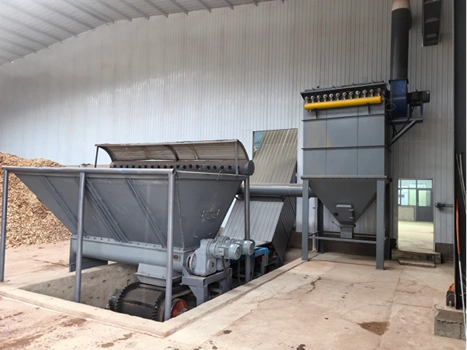
- Coal and biomass boilers must be sold with the air-quality package already engineered in. In Indonesia’s palm-oil sector, in Vietnam’s food & textile plants, and in the Philippines’ mining operations, a biomass or coal-fired DZL/SZL unit without a baghouse or ESP — and, where required, FGD and SCR — will fail commissioning.
- Stacks should be CEMS-ready. Thailand’s 2023–2024 rules and Malaysia’s >10 MW continuous-monitoring requirement mean the boiler scope of supply should include a flanged monitoring platform, sampling ports and pre-wired stack sections sized for the buyer’s CEMS vendor.
- Heavy-fuel oil is increasingly a stranded-fuel choice. Singapore’s 10 ppm sulphur cap, the region’s downward pressure on industrial fuel specifications, and carbon pricing together make HFO-fired boilers hard to justify for new projects.
- Existing boilers face a retrofit schedule. Vietnam’s 2024 regulation already triggered EPC contracts (e.g. the Quang Ninh thermal-power FGD/ESP upgrade signed in October 2026), and similar retrofit waves are expected elsewhere. Replacement with a new, lower-emission package is frequently cheaper than retrofitting a 15–20-year-old unit.
Which boiler configurations win in Southeast Asia right now
| Application / sector | Typical fuel | Recommended package | Emission add-ons to specify |
| Textile, F&B, dyeing, hotel (Vietnam, Thailand, Philippines) | Natural gas / LPG | WNS oil/gas firetube, 1–20 t/h | Low-NOx burner; economizer; CEMS-ready stack |
| Palm-oil mill, biomass processing (Indonesia, Malaysia) | Empty fruit bunch, fibre, shell | DZL / SZL biomass water-tube, 6–35 t/h | Multi-cyclone + baghouse; SNCR for NOx where tier limits require |
| Rice mill, sugar mill, small industrial (Vietnam, Thailand) | Rice husk / coal / wood | DZL chain-grate, 2–20 t/h | Cyclone + baghouse; spark arrester |
| Pulp & paper, chemical, district heating (Thailand, Malaysia) | Natural gas; sometimes coal | SZS / SZS-D water-tube, 10–80 t/h | Low-NOx burner; SCR for large coal units; FGD if high-sulphur coal |
| Pharma, fine chemicals, food-grade (Singapore) | Natural gas; electricity back-up | WNS / SZS gas-fired, fully packaged | Low-NOx burner; NEA stack height & design compliance |
Outlook
The direction of travel across ASEAN is unambiguous: limits are tightening, monitoring is becoming continuous and public, and carbon costs are being layered on top of stack-limit compliance. Over the next 24–36 months we expect Vietnam’s QCVN 19:2024 retrofit wave, further CEMS expansion in Thailand, and a likely review of Philippine and Indonesian numeric ceilings. For a boiler manufacturer, that means competitiveness in Southeast Asia is no longer decided by pressure rating or steam output alone — it is decided by how completely the emission-control package can be quoted as one shipment.
How Genjux supports Southeast Asian buyers
At Genjux Boiler, our WNS oil/gas-fired firetube, SZS water-tube, and DZL/SZL biomass/coal packages are configured at order time with low-NOx burners, economizers, condensers, baghouses/ESP, SNCR/SCR and FGD skids, plus CEMS-ready stack interfaces. We routinely quote for projects bound by Vietnam QCVN 19:2024, Thailand CEMS annexes, Malaysia Clean Air Regulations 2014, Indonesia KLHK PermenLHK 15/2019, and DENR-EMB permit requirements in the Philippines. Send us your steam capacity, fuel type and target market, and we will return a compliance-aligned proposal within three working days.
Contact our Southeast Asia team → [[email protected]] | Link to Product Page >>